The basic agenda of the ANC – from native union to African claims
In a document titled “The Regeneration of Africa”i, dated 5 April 1906, one of the founders of the African National Congress (ANC), Pixley ka Isaka Seme, wrote: “From these heights of the 20th century I again ask you to cast your eyes south of the Desert of Sahara. If you could go with me to the oppressed Congos and ask, What does it mean, that now, for liberty, they fight like men and die like martyrs; if you would go with me to Bechuanaland, face their council of headmen and ask what motives caused them recently to decree so emphatically that alcoholic drinks shall not enter their country – visit their king, Khama, ask for what cause he leaves the gold and ivory palace of his ancestors, its mountain strongholds and all its august ceremony, to wander daily from village to village through all his kingdom, without a guard or any decoration of his rank – a preacher of industry and education, and an apostle of the new order of things; if you would ask Menelik what means this that Abyssinia is now looking across the ocean – oh, if you could read the letters that come to us from Zululand – you too would be convinced that the elevation of the African race is evidently a part of the new order of things that belong to this new and powerful period.”
He went on to speak of Africa and “her chains dissolved, her desert plains red with harvest, her Abyssinia and her Zululand the seats of science and religion, reflecting the glory of the rising sun from the spires of their churches and universities. Her Congo and her Gambia whitened with commerce, her crowded cities sending forth the hum of business, and all her sons employed in advancing the victories of peace – greater and more abiding than the spoils of war.”
From as early as 1906, Seme identified racial oppression, conflict and wars, along with abuse of alcohol, as some of the key challenges to be overcome. He proposed the thesis of the Regeneration of Africa, concomitant with industry, education, science and religion, as necessary for peace, prosperity, liberty, commerce and development.
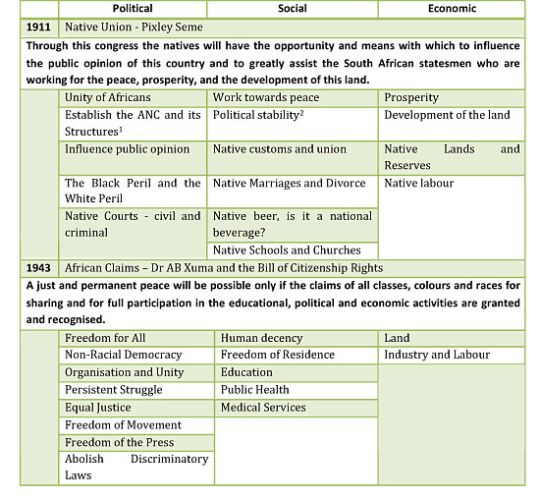
In another Document titled “Native Union”ii (24 October 1911), on the subject of the South African Native Congress (later to be called the African National Congress), Seme deemed it proper to focus on what he said was the “simple subject of native union” – a call for unity among Africans. This call for unity was based on the understanding that “cooperation is the key and the watchword which opens the door, the everlasting door which leads into progress and all national success. The greatest success shall come when man shall have learned to cooperate, not only with his own kith and kin, but with all peoples and with all life.”
An annual conference of the ANC that was held in Bloemfontein on December 16 1943 adopted resolutions that sought to interpret and adapt to our conditions the “Atlantic Charter”iii as an aspiration and claim of the African people to full citizenship of South Africa.
The Africans’ Claimsiv
The ANC resolved in 1943 that “if fascism and fascist tendencies were to be uprooted from the face of the earth, and to open the way for peace, prosperity and racial goodwill, the ‘Atlantic Charter’ had to apply to the whole British Empire, the United States of America and to all the nations of the world and their subject peoples”.
The ANC resolved that, as a precondition for South Africa’s participation at the peace conference in the final dismantling of Nazism and Fascism in Europe, South Africa had to grant the just claims of the black majority (Africans, coloured and Indians) to freedom, democracy and human decency.
The adaptation and interpretation of the Atlantic Charter in the South African context was to find expression in the “Bill of Citizenship Rights” for all races and colours to the honour and glory of the (at that time) Union of South Africa, whose ideals – freedom, democracy and human decency – could not be attained until all races in South Africa participated in them.
Evolution of ANC policy
iii The Atlantic Charter agreed upon by the president of the United States and the prime minister of Great Britain in their historic meeting of August 14 1941, and subsequently subscribed to by the other Allied Nations.
iv Africans’ Claims in South Africa: ANC Historical Documents Archive.
1 The key task of the executive committee of the Congress, according to Seme … be divided into two sections.
First section
– To formally establish the South African Native Congress as a national society or union for all the natives of South Africa.
– Consider, amend and adapt the constitution and rules for the society, union or congress.
– To elect officers for the ensuing year.
2 Second section
– The installation of officers.
– To take a vote of confidence on:
- General the Right Honourable Louis Botha
- The Honourable the Minister for Native Affairs